5 lessons solo survival in Rust teaches from Blooprint's Apex Survivor
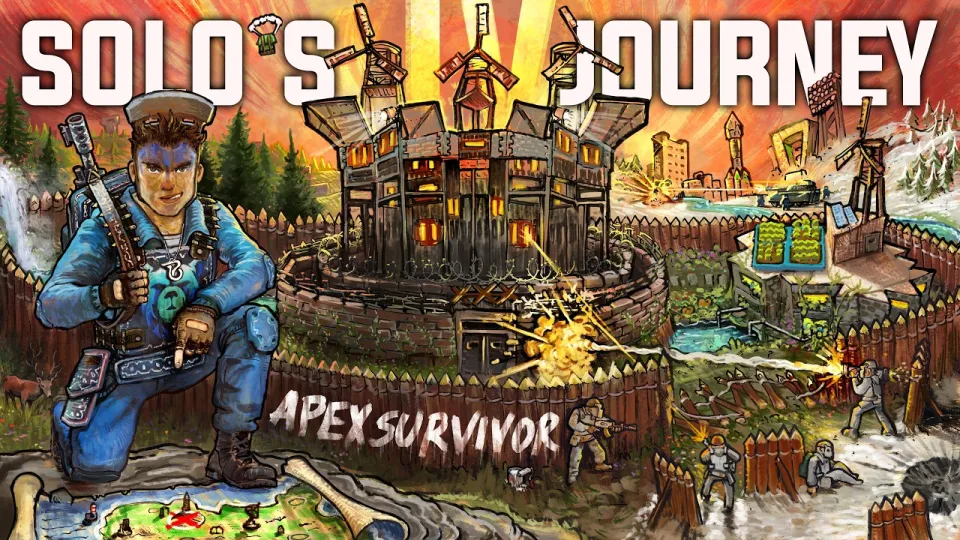
Video: Rust - A Solo's Journey IV: Apex Survivor (Movie)
You can order the same kind of articles for your own video to boost it on YouTube and Google. Just message the Telegram bot @sat_sit_bot. It writes articles around your video, embeds the video and publishes them on popular niche websites (no ads). Try it free: 50 articles on us.
· based on the channel Blooprint
Rust solo survival is a test of pacing, not reflexes: one player must farm, build, defend and raid without a clan to cover gaps, so the winners are usually the ones who plan the wipe in phases and protect a small, cheap base early. Blooprint's movie A Solo's Journey IV: Apex Survivor documents exactly that grind over 14 days of solo play, and a companion tracker at solosjourneytracker.com lets viewers type in a timestamp and see the run's progress at that exact moment. The film runs close to five hours across 13 chapters plus an ending, and it works as a case study in how a solo wipe is actually won.
What Apex Survivor actually is and how the run was built
Apex Survivor is a feature-length solo Rust movie, not a highlight reel. Blooprint filmed and edited the project himself and states that the work took well over 300 hours, released as a milestone for 2.5 million subscribers. The structure is deliberately serialised: an introduction, thirteen numbered chapters and a closing segment, each covering a stage of a 14-day solo wipe on a long-running server.
The supporting material matters as much as the gameplay. A dedicated tracking website was built specifically for the video so that a viewer can jump to any point and immediately understand what the player owns, what he has lost and what he is working toward. That is an unusual amount of infrastructure for a Rust video, and it turns a five-hour watch into something closer to a documented challenge run.
The four pillars a solo player has to balance
Solo Rust collapses four jobs into one schedule, and the movie's chapter structure mirrors that tension. The pillars are:
- Farming — stone, wood, metal and components for upkeep, weapons and raid tools. Solo farming is the largest single time cost and the easiest thing to lose to a single death.
- Base building — a compact footprint with layered doors, because a solo base cannot rely on numbers for defence. Small and awkward beats big and inviting.
- Combat and PvP — every fight is a risk calculation, since a lost kit is a lost hour of farming rather than a shared clan loss.
- Raiding and revenge — the payoff phase. Raiding solo means choosing targets whose loot justifies the sulphur and the exposure.
The movie's reputation in the comments centres on this balance rather than on any single fight: viewers describe the appeal as versatility, arguing that the same creator can deliver storytelling, PvP and long-form pacing in one package.
How a 14-day solo wipe is paced
A solo wipe is won in phases, and the film's chapter breaks reflect that rhythm. The opening days are about establishing a foothold: a starter base in a low-traffic area, enough tools to farm efficiently, and a first workbench so that better gear stops being a lottery. The middle of the wipe is where solos usually stall, because upkeep, deaths and the temptation to take every fight drain progress.
The late phase is where the run becomes a story. By then the player has either accumulated enough to raid or has been forced into a revenge cycle by neighbours. The film leans into that narrative arc deliberately — the editing, soundtrack and chapter titles treat the wipe as a season of a series rather than a session log. The community response reflects it: viewers describe finishing the whole thing in multiple sittings and treating the runtime as a feature, not a barrier.
Base design and farming choices that suit one player
A solo base in Rust should be cheap to maintain, annoying to raid and quick to rebuild. That means a small core with several door layers, storage split across rooms so one breach does not expose everything, and a location chosen for farming routes rather than for scenery. The movie's own approach drew praise for an unconventional core layout — commenters noted it was not meta but made up for it as a farm base, which is the correct trade-off for a solo: efficiency of movement beats theoretical raid cost.
Farming discipline follows the same logic. A solo player should farm in short, repeatable loops close to base, deposit often, and avoid hauling large loads across open ground. Cloning and planters, when available, convert a one-time investment into a passive supply of cloth and food — one of the few genuine force multipliers a solo has. Component runs to monuments and offshore locations such as oil rigs and cargo ships are high-value but high-risk, and the film treats them as set pieces precisely because a solo cannot afford to lose them casually.
Dealing with clans, neighbours and revenge
Clans are the defining hazard of solo Rust, and the film's answer is diplomacy mixed with timing. A solo cannot win a straight fight against numbers, so the practical rules are: avoid drawing attention during the build-up, keep the base visually uninteresting, and pick fights when the opposing group is already committed elsewhere.
Revenge is the emotional engine of the genre and the most expensive one. The movie's most-discussed moments involve settling scores with neighbouring groups, and the audience reaction — viewers calling a particular raid the most deserved they had seen — shows why: a solo raid lands harder when it is motivated by a specific grievance rather than by loot. The lesson is scheduling. A revenge raid should be planned around the target's offline hours and your own supply of explosives, not launched in the heat of a lost fight.
What the audience questioned about a five-hour Rust movie
Long-form Rust content raises predictable doubts, and the reaction to Apex Survivor answers most of them. The first is attention span: a runtime of nearly five hours looks like a gamble, yet the video drew millions of views, and viewers openly joked about needing a long meal to watch it — the length became the selling point rather than the obstacle.
The second is authenticity. A movie edit invites suspicion that the boring parts were cut and the run was easier than it looks, which is exactly why the public tracker exists: anyone can verify what the player owned at a given minute. The third is the human cost. Playing 14 days solo is genuinely draining, and the comments treat that endurance as the real achievement, alongside the editing workload. The fourth is whether the story holds up without playing Rust at all — many viewers said they had not touched the game in years and still watched the whole thing, which is the clearest sign the pacing worked.
Useful links from the video
- solosjourneytracker.com — the full checklist and timestamp-based progress tracker for the run.
- Blooprint Vinyl Figure on Youtooz — limited 2.5M subscriber merch, available until October 27, 2026.
- Solo's Journey mousepads and playmats on Epic Desk — available until January 3, 2027.
- Hires Studio — animated intro.
- Veys — thumbnail art.
Final thoughts on solo Rust and long-form storytelling
Apex Survivor works because it treats a solo wipe as a project with phases, not as a series of fights. The 14-day run, the 300-plus hours of production and the timestamp tracker all point the same way: preparation and pacing beat raw mechanical skill when one player is alone against groups. The film also confirms that Rust's audience will commit to long-form content when the structure earns it, and that a single well-documented challenge can carry a channel's biggest milestone. Blooprint, as the author of this run and its edit, sets a high bar for what a solo survival movie can be. If you want to follow the run step by step, start at solosjourneytracker.com and check the checklist against any timestamp in the video.
Key takeaways
- Blooprint survived 14 days solo in Rust and turned the run into a movie of roughly 4 hours 50 minutes across 13 chapters plus an epilogue.
- The creator reports more than 300 hours of filming and editing for the project, released to mark 2.5 million subscribers.
- A companion site, solosjourneytracker.com, lets viewers enter a timestamp and see the exact progress of the run at that moment.
- The movie is split into 13 chapters plus an ending, with the longest stretch covering a single phase of the wipe.
- Community reaction centred on the length itself: a multi-hour video pulling millions of views is treated as proof that long-form Rust content still works.
Questions & answers
How long is Blooprint's Apex Survivor and how is it structured?
The movie runs close to five hours and is divided into an introduction, thirteen numbered chapters and a final segment. Each chapter covers a distinct phase of a 14-day solo wipe, so it can be watched in parts without losing the thread.
Is the run really solo, or are there teammates helping?
It is a solo run: Blooprint plays alone for the full 14 days, which is why farming, base upkeep, defence and raiding all compete for the same time. The movie's appeal is largely about how one player manages those competing jobs without a clan.
What is the tracker website for and do I need it to enjoy the video?
The tracker at solosjourneytracker.com lets you enter a timestamp and see the player's progress at that point — base state, gear and goals. It is optional, but it makes a five-hour watch easier to follow and lets viewers verify the run was not edited into something easier than it was.
Can someone who has never played Rust still watch it?
Yes. Many viewers reported not having played Rust in years and still finishing the movie, because the chapters are built around a story arc rather than around unexplained mechanics. Basic knowledge of survival games helps, but the pacing and editing carry the experience.
Source: Rust - A Solo's Journey IV: Apex Survivor (Movie) · Markdown version